The Hobbit’s Legacy: From Page to Screen
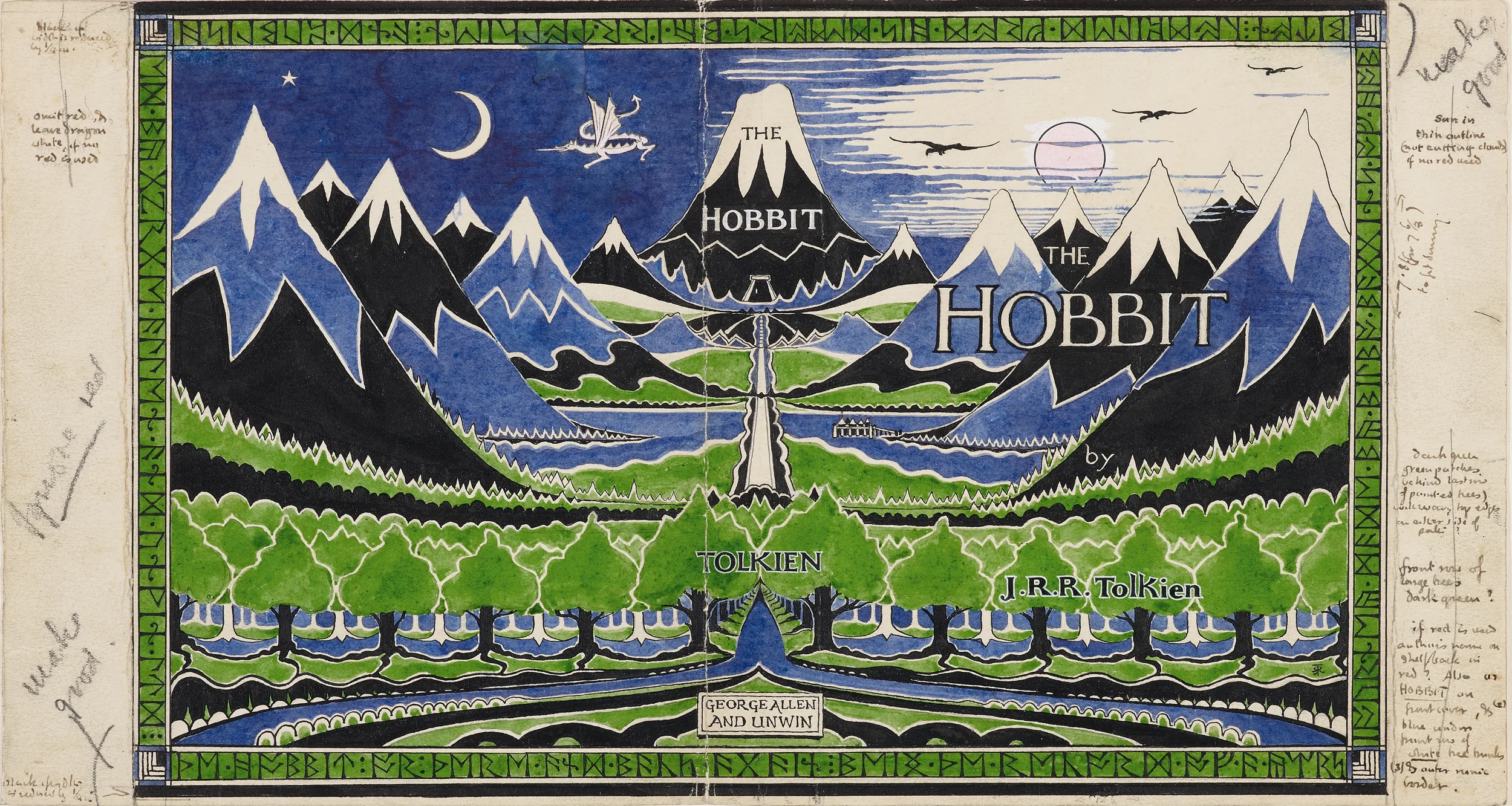
Drawing by J.R.R. Tolkien
Do you remember the first time you stepped into Middle-earth? Perhaps it was the musty smell of old paper in a library book, or maybe it was the swelling score of Howard Shore’s music filling a cinema. For me, it was a rainy afternoon with a battered paperback, reading that iconic opening line: "In a hole in the ground there lived a hobbit."
It seems so simple, doesn’t it? Yet, that single sentence sparked a revolution. I didn’t know where that journey would take me, but I remember feeling the world shift ever so slightly as those pages unfolded. It’s an experience that never quite leaves you—and every time I return to it, I’m that wide-eyed child again, heart thundering as Bilbo creeps down the dark tunnel towards Smaug.
It’s hard to overstate just how monumental The Hobbit is. It isn’t merely a charming prelude to The Lord of the Rings; it is the bedrock upon which so much of our modern fantasy genre is built. Whether you are a die-hard lore scholar debating the lineage of Durin, or a casual fan who just loves a good dragon story, we all owe a debt to Bilbo Baggins. Today, let’s take a stroll down memory lane together and delve deep into the legacy of this masterpiece—from its humble ink-and-paper beginnings to its vast cinematic adaptations and its undeniable influence on the games and stories we devour today.
The Birth of a Fantasy Classic
It is fascinating to think that this colossal legendarium began with a blank sheet of exam paper. As the story goes, Professor J.R.R. Tolkien was marking school certificate papers—a tedious task, I’m sure—when he impulsively scribbled those famous words about a hobbit. He didn’t know why, and he didn’t know what a hobbit was. But his curiosity, driven by that fervent imagination of his, led him to find out.
There’s something so wonderfully human about that moment—creativity leaping out from the monotony of daily life. I find myself smiling at the thought that one of the world’s greatest adventures started this way, not unlike Bilbo’s own unassuming beginning in Bag End. It makes me ponder the small sparks of inspiration we all carry in our everyday routines, those quiet, nearly missed moments that could—if we follow them—unfurl into entire worlds of adventure.
When The Hobbit was published in 1937, the literary landscape was quite different. Fantasy as a distinct marketing genre didn’t really exist in the way we see it on bookshop shelves now. There were fairy tales for children and myths for scholars, but Tolkien bridged that gap. He gave us a "children’s story" that treated its young audience with immense respect, refusing to talk down to them.
The reception was warm, but I don’t think anyone at the time—not even Tolkien himself—realised they were witnessing the birth of a phenomenon. It was the success of The Hobbit that prompted the publisher, Stanley Unwin, to ask for a sequel. That request, of course, spiralled into the epic The Lord of the Rings. Without Bilbo’s initial stumble out the door, we might never have had the War of the Ring. Sometimes, the smallest beginnings really do make for the greatest tales.
What really fascinates me is how the book, meant for children, so elegantly bridges the gap between childlike wonder and adult reflection. When I read it as a child, it was about goblins, trolls, and riddles in the dark. As an adult, I marvel at the subtle wit, the sly humour, and the poignancy of Bilbo’s journey home. It’s a rare gift in literature to speak to every part of a reader’s life, and Tolkien has that in abundance.
World-Building: Setting the Bar for Second Worlds
If you have ever played a tabletop RPG or read a modern fantasy series, you have walked in Tolkien’s shadow. Before The Hobbit, magical worlds were often dreamscapes or vaguely defined fairylands. Tolkien changed the game by introducing rigour to the magic.
Middle-earth feels real. It feels historical. When you read The Hobbit, you get the distinct sense that the Misty Mountains and Mirkwood exist even when the characters aren’t looking at them. Tolkien famously utilised "sub-creation," the idea of building a secondary world with its own consistent internal logic, geography, and history.
Even in The Hobbit, which is lighter in tone than its sequel, the depth is staggering. Consider the references to Gondolin, the ancient swords Orcrist and Glamdring, or the history of the Dwarves of Erebor. These aren’t just flavour text; they are crumbs of a much larger, ancient history that Tolkien had been constructing in his mind for years.
Most of my favourite fantasy worlds—the ones I return to again and again—borrow their weight and texture from this approach. Now, when we pick up a book by Brandon Sanderson or George R.R. Martin, we expect maps. We expect lineages. We expect a world that breathes. I often catch myself poring over fantasy appendices, tracing family trees, or marvelling at invented languages, and it always comes back to Tolkien. He taught us that a fantasy world should be as tangible as our own, with dirt under its fingernails and history in its ruins.
I remember the first time I saw the fold-out map in the back of The Hobbit. I must have spent half an afternoon just tracing Bilbo’s journey from Bag End to the Lonely Mountain, conjuring the landscape in my imagination. I drew my own maps as a child, dreaming of lost kingdoms and enchanted forests. These details matter—they invite us not just to read, but to explore. Tolkien’s world-building is an open invitation to curiosity and discovery.
If you’ve ever argued passionately about the difference between orcs and goblins, or spent hours creating characters for Dungeons & Dragons, you are living proof of how profoundly Tolkien redefined what fantasy could be.
The Power of Timeless Themes
Why do we keep coming back to this story? Is it just the dragons and magic rings? I don’t think so. I believe it’s because The Hobbit speaks to something fundamental in the human spirit.
At its core, this is a story about the unlikeliest of heroes. Bilbo Baggins is not a warrior. He isn’t a chosen one with a destiny carved in stone. He is a middle-aged fellow who likes his armchairs, his pocket handkerchiefs, and his six meals a day. Isn’t that relatable? I see so much of myself in Bilbo’s reluctance and his love for comfort. We aren’t all Aragorns, striding confidently into battle. Most of us are Bilbos—frightened, fond of comfort, but capable of surprising courage when pushed.
The themes of The Hobbit resonate because they are universal:
Courage is not the absence of fear. Bilbo is terrified constantly, yet he goes on. That is true bravery.
Greed vs. Fellowship. The "dragon sickness" that takes Thorin Oakenshield is a powerful warning about how obsession with material wealth can destroy friendships.
There is more in you than you know. Gandalf sees something in Bilbo that Bilbo doesn’t see in himself. I remember reading that as a teenager, feeling somehow seen. It’s a beautiful reminder that we are all capable of more than we give ourselves credit for.
Whether I read this book at age ten or age forty, these themes hit home, morphing in meaning as I grow and change. It comforts me to know that even small people can change the course of the future, and reminds me that stepping out my door—literally or figuratively—might just lead me somewhere magical.
On more than one occasion, I’ve found encouragement in Bilbo’s journey—especially in those moments where comfort feels safer than adventure. I recall a time when I was contemplating a big leap, a move to a new city for a dream job. What kept echoing in my head? Gandalf’s gentle nudge: "You are a very fine person, Mr. Baggins, and I'm very fond of you; but you are only quite a little fellow in a wide world after all!" Only by stepping outside, did Bilbo—and did I—discover what worlds awaited.
And that’s the magic of Tolkien. He gives us stories that are epic and personal at the same time. With every reread, I find myself learning something new—about the world, about the people I love, about myself.
From Page to Screen: The Adaptation Journey
Now, we have to talk about the adaptations. This is where things often get heated in our community, isn’t it?
For decades, The Hobbit was considered difficult to adapt. We had the 1977 animated version by Rankin/Bass—which, let’s be honest, has a nostalgic charm that is hard to beat. The music in that version? Absolute gold. "The Greatest Adventure" still gives me chills, and I’ll admit to humming it when no one’s around.
I remember gathering with friends for a film night, all of us bundled into sleeping bags, reciting scenes as if they were sacred rites. Those old animations had a warmth to them, perhaps not in polish, but in earnestness. My favourite part was always Gollum’s riddle game—an early introduction to the captivating weirdness that is so essential to Tolkien.
Then came Peter Jackson. After the monumental success of The Lord of the Rings trilogy, the expectations for The Hobbit films were sky-high. When it was announced as a trilogy, I’ll admit, I was sceptical. I remember sitting in the midnight premiere, torn between anticipation and doubt. Stretching a relatively short children’s book into three epic films was a bold, controversial move.
Did it work perfectly? That’s up for debate. The films certainly added a lot of material—some from the appendices, some invented entirely (I’m looking at you, Tauriel love triangle). But regardless of where you stand on the pacing or the CGI orcs, you cannot deny the visual splendour. Seeing Erebor in its prime, witnessing Smaug in all his terrifying glory—it was a feast for the eyes, and in those moments, I felt like a child again, wide-eyed and awestruck.
One thing stood out above all: Martin Freeman’s portrayal of Bilbo. He captured the hobbit’s reluctance, humour, and eventual bravery so perfectly. Watching him banter with Gandalf or navigate the dragon’s lair, I found myself rooting for Bilbo all over again. And how could I possibly forget Benedict Cumberbatch’s Smaug? That chuckle, that rolling, silky menace—if ever a fictional dragon needed a BAFTA, it was then!
Even more importantly, these films expanded the fandom. They brought a new generation into the fold. I have met so many younger fans whose first exposure to Middle-earth was Martin Freeman’s brilliant portrayal of Bilbo. New faces at conventions and fan forums have shared stories of discovering Tolkien thanks to the films. If the movies lead people back to the books, then I say they have done their job, building the fellowship even larger.
And who among us hasn’t spent an afternoon attempting to sing Misty Mountains with friends, voices dropping to deliciously deep lows—half-sincere, half-joyful parody? Moments like that turn fandom into a living, breathing community.
The Fandom Phenomenon
Speaking of fans, look at us! The community that has sprung up around Tolkien’s work is nothing short of miraculous. It is one of the oldest and most passionate fandoms in existence.
The Hobbit plays a crucial role here. It is often the gateway, the accessible entry point before one tackles the denser prose of The Silmarillion. The fandom keeps this world alive through incredible creativity. I’ve spent hours browsing fan art and reading fan fiction that explores the untold stories of the Dwarves. I will never tire of cosplay photos from conventions, seeing Bag End and the Lonely Mountain lovingly recreated in costumes and dioramas that radiate shared joy.
There’s an unmatched delight in attending a convention and seeing someone dressed to the nines as Thorin, axe slung over the shoulder, or watching a panel of fans debate the merits of goblin-town music. I still have a cherished hand-crocheted Smaug gifted by a fellow fan, a token of friendship forged over theories about Middle-earth’s Second Age.
We gather in forums to debate the riddles in the dark, or we swap baking tips for seed cakes and attempt (hilariously) to brew our own "Gandalf’s tea." This shared passion creates a sense of belonging that is rare in this world. On tough days, knowing this community is out there can feel like having your own band of adventurers at your side.
I keep a folder on my computer filled with digital art—scenes of the Shire under a lavender sky, portraits of Bilbo clutching the Arkenstone, lush panoramas of Mirkwood and Erebor. Each piece is a fresh perspective, a new way to see this world we love. And it never ceases to amaze me: The Hobbit is a story we keep telling together, in art, music, performance, and endless conversation.
The Hobbit’s Influence on Modern Fantasy
If you look closely at modern fantasy, you can see the DNA of The Hobbit everywhere. It’s inescapable.
Dungeons & Dragons: The entire concept of the "adventuring party" owes everything to Thorin and Company. The classes, the races (specifically Halflings), the loot-filled dungeons—it’s all pure Tolkien.
Video Games: From The Elder Scrolls to World of Warcraft, the aesthetic of fantasy gaming is deeply rooted in the visual language established by Middle-earth.
Literature: Writers like Terry Brooks, J.K. Rowling, and Neil Gaiman have all acknowledged Tolkien’s influence. He created the playground that everyone else is now playing in.
Even the trope of the "quest" finds its quintessential form here. Before The Hobbit, fantasy heroes were often demigods or knights. Tolkien gave us the "quest for the ordinary person." He democratised heroism in fantasy fiction.
Looking at my own bookshelf—brimming with worlds and wonders—I see Tolkien’s fingerprints everywhere. My gaming dice have rolled through many a Tolkien-inspired dungeon.
I think about campaigns I’ve played with friends where our band of misfits set out, full of nerves and hope, to do something grand or ridiculous—or both. There’s always that moment, before the journey begins, where someone hesitates. Inevitably, someone nudges them along with a version of Gandalf’s encouragement. In that way, The Hobbit is present at every table where dice clatter and stories spin.
Writers across the last century have picked up Tolkien’s mantle, exploring themes of community, courage, and the unknown. You can sense his spirit in every well-written fellowship, every lovingly rendered map, every story that dares its readers to take a small risk and dream big.
Why The Hobbit Still Resonates Today
So, why do we still care? Why, nearly a century later, are we still talking about a burglar and a dragon?
I think it is because we need Middle-earth. In a world that often feels industrialised, cynical, and fast-paced, The Hobbit offers a return to something elemental. It reminds us of the value of nature, of loyalty, and of a simple song by the fire.
And I’ll be honest: in uncertain times, returning to Bilbo’s journey feels a little like coming home. I pick up the book on stormy nights, and somehow the world feels a bit brighter, a bit kinder.
There’s a scene in the book—when Bilbo and the dwarves rest among the eagles, high above the vast, dangerous world. I always pause at that passage. It perfectly captures the wonder and the longing that fantasy kindles. Sometimes, I wish I could bottle that feeling, carry it in my pocket for hard days.
It also reminds us that adventure is out there, if we are willing to step out the door. We might not fight goblins, but we all have our own mountains to climb. We all have our own Smaugs to face. Bilbo’s journey validates our own struggles and triumphs. It tells us that it is perfectly fine to be afraid, and even acceptable to miss your bed, but you must keep going.
In recent years, I’ve introduced The Hobbit to friends who were new to fantasy—some hesitant, some sceptical. Seeing them moved by Bilbo’s courage, surprised by how the story lingered, has been a joy. The book acts as a gentle invitation: Come in, have a scone, there’s an adventure waiting, and a place for you at the table.
Conclusion
The Hobbit is more than a book; it is a legacy. It is a torch passed down from J.R.R. Tolkien to us, illuminating the dark corners of our imagination. It fundamentally changed how we tell stories, how we build worlds, and how we view heroes.
If it has been a while since you walked the road to Erebor, I urge you to pick it up again. Read it to your children, or read it for yourself on a quiet evening. Let the magic wash over you anew. For me, it’s often a favourite chapter or even a quiet reread of Bilbo’s riddle contest that brings comfort and a sense of belonging, no matter how many times I journey there.
And if you’ve never read it? Oh, I envy you. You have a magnificent journey ahead. Be ready for elves in moonlit forests, grumpy dwarves with golden hearts, rollicking riddles, and the deep, quiet courage of a hobbit who teaches us that adventure truly begins with a single, brave step outside your door.
Quest logged, quest complete.
What is your favourite memory of The Hobbit? Is it a particular scene from the book, a treasured reread moment, or perhaps a moment from the films that took your breath away? Join the discussion in the comments below or head over to our forums—we’d love to hear your tale!