The Odyssey – The Long Road Home
52 Books in a Year – Week 3
Welcome back to my 2026 book challenge. 52 Books in a Year. Still sounds mental, still going. I have to say I am enjoying the journey at the moment. It’s different to my day to day life and is refreshing. So if you’re reading this, thanks for stopping by and hope you’re getting some fun out of it like myself!
Much like The Iliad, I am late on this one. Finished it earlier in the year, but enjoyed this one in particular due to the excitement of the news of Christopher Nolan's adaptation trailer that dropped. I mean that guy, every time - the only director that makes me want to go to Imax, sometimes James Cameron too I guess.
So, The Odyssey is one of those stories that attracts even the most creative of minds to explore. After reading The Iliad, I expected it to be about the end of the Trojan war. Which it was essentially. But I didn’t know about the epic adventure of Odysseus’s journey home.
So yes, The Odyssey is not about winning. It’s about getting home.
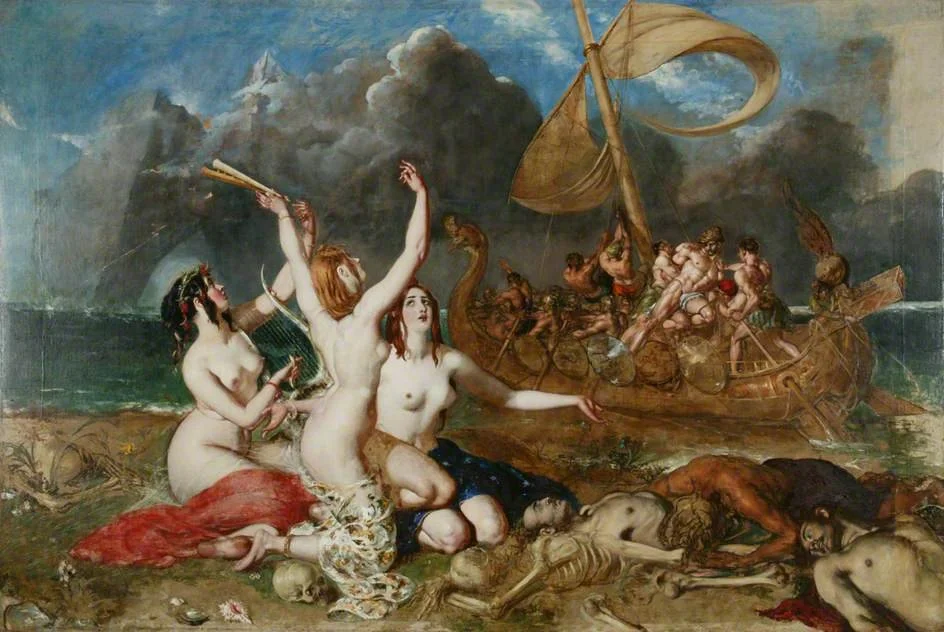
What in the world is going on here, seeing naked women over corpses and bones wouldn’t want me to land ashore. And is it me or is there a titan or God in the dark clouds behind them? Either way this adventure is F***ed.
Every adventure starts with a hero and Not All Heroes Are Built the Same
If Achilles is the embodiment of rage, then Odysseus is something else entirely. He is not the strongest man in the room. He is not the most dangerous. But he adapts.
Where Achilles charges forward, Odysseus waits. Thinks. Survives. I wonder if Homer knew this was the direction he was going to take when he started, or was influenced by feedback.
We see this hero shift immediately in one of the most famous moments in the text — the encounter with the Cyclops, Polyphemus. Odysseus doesn’t defeat him through strength. He gets him drunk. Blinds him. Then escapes by calling himself “Nobody” — so when the Cyclops cries out, no one comes to help. I found that funny.
But what surprised me is it’s also where we see Odysseus’s flaw. Because as he sails away, he cannot help himself. He reveals his name. Claims victory. And in doing so, he invites Poseidon’s wrath upon himself and his men. There it is again. Ego.
That moment for me defines him.
Odysseus is a man constantly caught between intelligence and ego, rather than fighting ability and ego. A fair battle that we all experience, some more than others of course.
A Story About Stories
One of the most fascinating aspects of The Odyssey is how it is told. This isn’t a straight journey from A to B. Odysseus himself becomes the storyteller. When he arrives among the Phaeacians, it is he who recounts his adventures — the Lotus-Eaters, Circe, the Underworld, the Sirens. We are not just hearing what happened. We are hearing his version of what happened. Some could say he was guilty like Beowulf of elevating his tales, which every good storyteller does to be fair to him.
So that raises an interesting question. Is Odysseus a hero… or just a very good narrator? Because memory is selective and storytelling is performance. Combined makes the ingredients of an epic tale.
Odysseus in many ways was crafting his own legend as he speaks. And he was good at it! Imagine he didn’t come up with the horse, and that it was some other soldier he threw off the edge of his long ship, so he can take the glory for himself, after being in the shadow of warriors like Achilles, Hector and Ajax.
The Monsters Are the Point
What I did really enjoy was, on the surface, The Odyssey is filled with iconic creatures and moments. The Cyclops. The Sirens. Scylla and Charybdis. Circe. Calypso. But none of them is just an obstacle. They are tests. Myths and legends were born. Influencing fantasy even today.
Take the Sirens, for example. Odysseus orders his men to plug their ears with wax, while he has himself tied to the mast so he can hear their song. He wants knowledge, but knows he cannot trust himself with it.
“Bind me hand and foot in the swift ship… so I may hear the Sirens’ song.”
That moment says everything.
He is curious. Driven. But also aware of his own weakness.
Then there is Calypso — offering him immortality, an eternity free from struggle. And he refuses. An interesting thought after reading Epic of Gilgamesh not long ago. Does Odysseus have more honour then Gilgamesh?
Then I really loved the idea that he turned it down not because it isn’t tempting, but because it isn’t home. I mean come on. Who doesn’t love returning home after being away. A strange phenomenon occurs, a sense of belonging. Something time takes away from you the longer you are away.
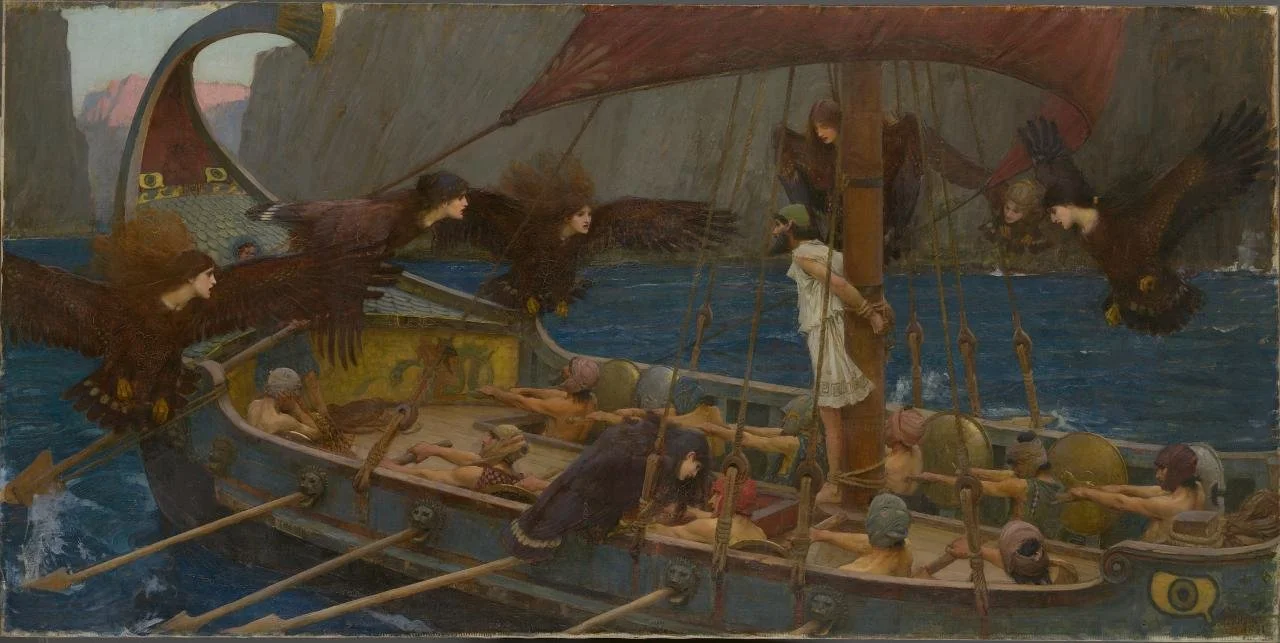
Very cool image, but damn, if I saw some seagulls down in the British coast with human heads… I’d be throwing my chips in the air to let them have them.
Home Is Not What It Was
This is where The Odyssey hits differently. The urge to return home. But to get there, it is no easy feat. There is no place like home. There is no place like home. There is no place like home. When Odysseus finally reaches Ithaca, he does not walk in as a king. He arrives disguised as a beggar. Watching. Assessing. Waiting. Even in his own home, he is cautious. Because time has moved on without him. Suitors have overrun his house. They feast on his wealth, disrespect his name, and attempt to claim Penelope as their own.
And Penelope… might be the strongest character in the entire story.
Penelope – The Quiet War
While Odysseus fights monsters and gods, Penelope fights something else entirely.
Time. Pressure. Expectation.
She holds off the suitors not with force, but with intelligence. Promising to choose a husband once she finishes weaving a shroud — only to unravel it each night..
In many ways, she mirrors Odysseus. Both are surviving. Both are delaying. Both are playing a long game.
The Gods – Less Chaos, More Control
Compared to The Iliad, the gods here feel… different. Less like unpredictable forces of chaos, and more like guiding hands shaping the path. Although there is still a sense of human pettiness in them. Athena stands firmly behind Odysseus — guiding, protecting.
Poseidon, on the other hand, is relentless. His anger following the blinding of his son defines the entire journey. He will come home late… in pain… having lost all his comrades.
The Core of It All
At its heart, The Odyssey is about one thing.
Home.
But not the romantic version of it.
Even his reunion with Penelope is not immediate. She tests him. Questions him. Needs proof.
And when he finally reveals himself, it is not through strength. It is through knowledge.
The bed he built — rooted into the earth itself — something only he would know.
I enjoyed it, because for me home is not just a place, it is everything.
Final Verdict
★★★★★ (5/5)
Not because it is perfect. I don’t deny it is a tough read. It is timeless and has a contributing factor to the foundations of the genre I love, Fantasy.
Next Up: The Aeneid - The Iliad – Rage, Honour, and the Cost of Glory